Saga Metals Mobilizes for Major Drill Program at Radar Project in Labrador, Targeting Maiden Mineral Resource Estimate
Key Highlights:
- Crew mobilization is underway to support a 15,000-metre drill program at the Radar Ti-V-Fe Project in Labrador, Canada.
- Drilling is focused on advancing the Trapper Zone’s 3+ km strike toward a maiden MRE highlighting titanium, vanadium, and iron ore—critical minerals for the global energy transition.
- Ongoing site work includes trench mapping, surveying, and full camp establishment to optimize drill execution.
- Infrastructure is in place with new access trails along the oxide layering strike through the Trapper Zone.
VANCOUVER, British Columbia, Sept. 23, 2025 (GLOBE NEWSWIRE) -- SAGA Metals Corp. ("SAGA" or the "Company") (TSXV: SAGA) (OTCQB: SAGMF) (FSE: 20H), a North American exploration company focused on critical minerals, is pleased to announce the mobilization of crews to its 100% owned Radar Titanium-Vanadium-Iron (Ti-V-Fe) Project in southern Labrador, Canada. This mobilization marks a significant step in preparing for a major drill program aimed at expanding known mineralization and advancing toward the completion of a maiden mineral resource estimate (MRE) on the project.
Preparation begins for a 15,000m Drill Program at the Radar Ti-V-Fe Project:
Field preparations are underway across the Radar Project’s Trapper Zone, which spans over a 3+ km strike of oxide mineralization. Current work is designed to strengthen drill targeting, maximize efficiency, and ensure high-quality geological data accuracy for the MRE, including:
1. Enhanced Trench Analysis
Building on approximately 504 square metres (5,425 ft²) of trenching completed to date, SAGA is conducting additional high-pressure power washing and detailed geological mapping in three trenches within the Trapper Zone. This work exposes clean bedrock surfaces by removing overburden and vegetation, allowing geologists to document rock types, mineral textures, and oxide layering trends with precision. The process will help refine 3D geological models, confirm continuity of vanadiferous titanomagnetite (VTM) mineralization, and identify the most prospective high-grade drill targets.
2. Surveying and Geophysical Preparation
Crews are also executing a comprehensive surveying program to support drill collar placement and spatial accuracy across the Trapper Zone. Using high-precision GPS, total stations, and laser scanning technology, the team is mapping the newly built 4 km Trapper Trail access route, establishing a geophysics baseline, and cutting grid lines (cutlines) through vegetation to enable further geophysical traverses. The geophysics baseline will serve as a calibration reference for magnetometer instruments, ensuring consistent and reliable detection of anomalies that may indicate subsurface mineralization. Collectively, these surveys are designed to eliminate spatial errors in modelling and optimize drill hole targeting
3. Establishing Full Camp Infrastructure
To support the scale of the upcoming 15,000 metre drill program, SAGA has secured land near Cartwright, Labrador, for the establishment of a fully serviced exploration camp. The camp will include accommodations, a kitchen trailer, a core shack for drill core logging and storage, an office for data management, and a cut shack for sample preparation. Utility infrastructure—including power generation, water storage and filtration, and septic systems—is being installed to ensure long-term operational stability. With this infrastructure in place, SAGA is positioned to support long-term stability and efficiency for the crews managing this milestone drill program.
"This mobilization is a pivotal moment for the Radar Project as we move from early exploration success toward defining a mineral resource," said Mike Stier, CEO and Director of Saga Metals Corp. "By investing in thorough trench mapping, advanced surveying, and robust camp infrastructure, we are positioning the Radar Project for a highly efficient 15,000 metre drill program. We believe this campaign has the potential to unlock significant value in titanium, vanadium, and iron—critical minerals essential to the global energy transition. Our priority is to advance Radar toward a mineral resource estimate and deliver value to our shareholders."
The preparation phase is expected to conclude in the coming weeks, with the 15,000m drilling program scheduled to commence in early November 2025.
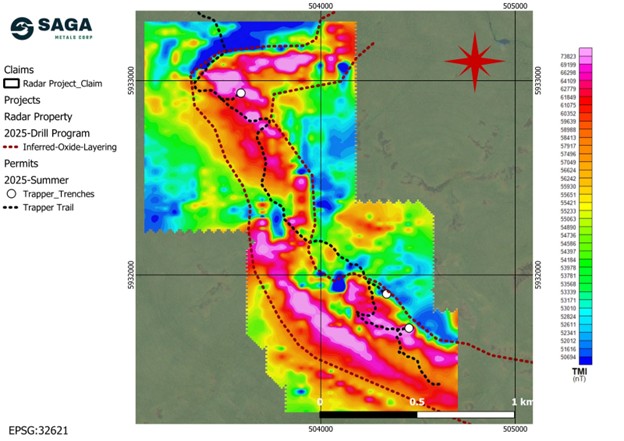
Figure 1: Radar Project’s Trapper Zone depicting a 3+ km magnetic anomaly and oxide layering trend. The Trapper Trail (in black) will be the target of the planned 15,000 m diamond drilling program aimed at establishing Saga’s maiden mineral resource estimation.
Summary of the Radar Ti-V-Fe Project in Labrador, Canada:
The Radar Property benefits from exceptional infrastructure, including all-season road access, a nearby deep-water port, hydroelectric power, and an airstrip with claims just 10 km from Cartwright, Labrador. Spanning 24,175 hectares, the Property covers all the Dykes River intrusive complex—an extensive (~160 km²) Mesoproterozoic layered mafic intrusion. Unique amongst Western exploration companies, SAGA controls its entire intrusive complex.
Grenville-age mafic layered intrusions of Québec and Labrador represent a significant but underdeveloped titanium–vanadium–iron resource province. These layered intrusions, emplaced during the Grenvillian orogeny, locally host thick oxide-rich cumulate zones dominated by titanomagnetite and hemo-ilmenite with accessory vanadium and phosphorus. Their scale and metallogenic affinity are directly comparable to major Fe–Ti–V deposits such as Lac Tio (Quebec), Panzhihua (China), Tellnes (Norway) and Bushveld (South Africa), which supply a major share of global TiO₂ feedstock and vanadium for steel alloys and emerging energy storage markets. The combination of large tonnage potential, favourable logistics, and critical mineral content positions the Grenville intrusions, such as Radar’s Dykes River complex, as strategic candidates for development in the context of growing North American demand for titanium, vanadium and high-quality iron.
Early geological mapping, government magnetic surveys and ground-based geophysics of the Radar property have identified oxide layering across more than 20 km of strike length, with mineralized zones remaining open for expansion. Vanadiferous titanomagnetite (“VTM”) is the principal oxide and occurs as cumulate and intercumulus mineralization over large thicknesses of the Dykes River layered intrusion.
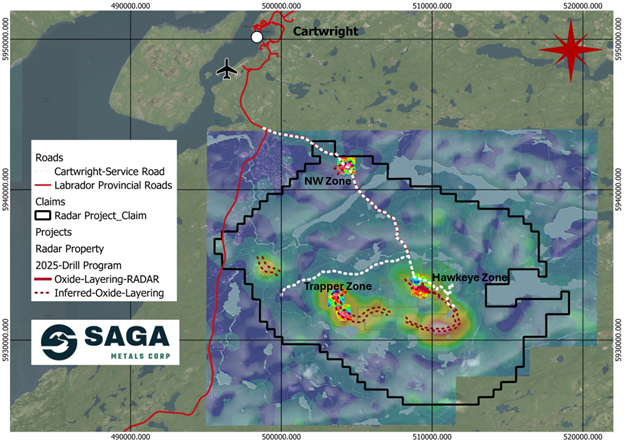
Figure 2: Radar Property map, depicting magnetic anomalies, oxide layering and the site of the 2025 drill program in the Hawkeye zone. The Property is well serviced by road access and is conveniently located near the town of Cartwright, Labrador. A compilation of historical aeromagnetic anomalies is overlaid by ground-based geophysics as shown. SAGA has demonstrated the reliability of the regional airborne magnetic surveys after ground-truthing and drilling in the 2024 and 2025 field programs.
SAGA’s 2025 Winter Drill Program at Radar:
Saga completed its maiden drill program in early 2025, featuring a 2,209-metre, seven-hole diamond drill campaign across the Hawkeye Zone—a combination of 3D magnetic inversion modeling and surface VLF-EM results guided drill targeting. The program intersected broad zones of titanomagnetite-rich oxide layering, with cumulative intersections displaying consistent grades of titanium dioxide (TiO2), vanadium pentoxide (V2O5) and iron (Fe).
Similarities in the ratios of TiO2 and V2O5 to Fe3O4 across multiple drill holes serve to identify discrete igneous layers. Within the 600 m tested thickness of the layered gabbronorite, the chemistry delineates a very promising 300-400 m thickness, referred to as the Lower Cumulate Layer. The highest V2O5 assays are in the lower 100-200 m, coinciding with the highest-grade intervals of VTMs. The layer is comprised of interlayered gabbronorite and bands of semi-massive to massive VTM.
Drill holes R25-HEZ-01, -07, -04, and -05 intersect this Lower Cumulate Layer. The chemistry indicates that the layer was deposited from a large-volume pulse of Ti-V-Fe-enriched magma. Saga will be targeting this same discrete intrusive horizon along the Trapper Zone’s 3+ km strike length.
Magnetic and VLF-EM Survey to Extend the ‘Trapper Zone’
As crews prepare for the 15,000 m drill program, a small geophysics team will continue a ground-based magnetic survey over the northern and southern extensions of the Trapper Zone. The survey utilizes a GSM-19 magnetometer to collect magnetic-field and VLF-EM data (using VLF Transmitter Cutler).
The survey is conducted using a grid of N-S lines, spaced 50 m apart, with observations made at stations spaced 20 m apart along the lines. The tightly gridded stations will be used to map the extent to which the oxide layering strike continues to the NE-E at the top of the zone and SE-E at the bottom of the zone, both trending back towards the Hawkeye Zone.
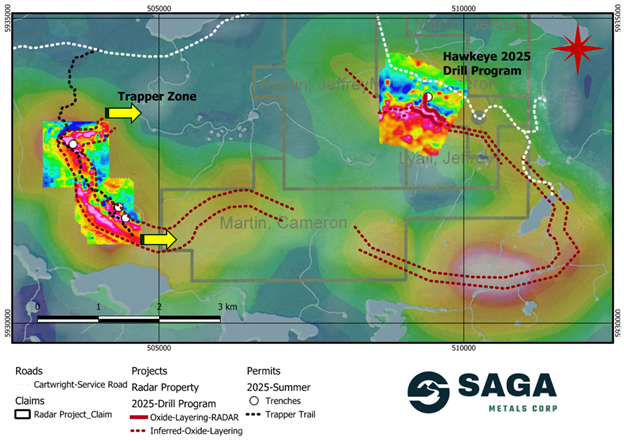
Figure 3: Radar Project’s prospective oxide layering zone extends for an inferred 20 km strike length, as shown on a compilation of historical airborne geophysics as well as ground-based geophysics in the Hawkeye and Trapper zones completed by SAGA in the 2024/2025 field programs. SAGA has demonstrated the reliability of the regional airborne magnetic surveys after ground-truthing and drilling in the 2024 and 2025 field programs.
Saga Metals’ Corporate Video
Please find below Saga Metals’ corporate video, produced by Pinnacle Digest, providing an overview of the Company as well as highlighting the key characteristics and developments of the Radar Titanium-Vanadium-Iron (Ti-V-Fe) Project in Labrador, Canada.
A Media Snippet accompanying this announcement is available by clicking on this link.
Qualified Person
Paul J. McGuigan, P. Geo., is an Independent Qualified Person as defined under National Instrument 43-101 and has reviewed and approved the technical information related to the Radar Ti-V-Fe Project disclosed in this news release.
About SAGA Metals Corp.
SAGA Metals Corp. is a North American mining company focused on the exploration and discovery of a diversified suite of critical minerals that support the global transition to green energy. The Radar Titanium Project comprises 24,175 hectares and entirely encloses the Dykes River intrusive complex, mapped at 160 km² on the surface near Cartwright, Labrador. Exploration to date, including a 2,200m drill program, has confirmed a large and mineralized layered mafic intrusion hosting vanadiferous titanomagnetite (VTM) with strong grades of titanium and vanadium.
The Double Mer Uranium Project, also in Labrador, covers 25,600 hectares featuring uranium radiometrics that highlight an 18km east-west trend, with a confirmed 14km section producing samples as high as 0.428% U3O8 and uranium uranophane was identified in several areas of highest radiometric response (2024 Double Mer Technical Report).
Additionally, SAGA owns the Legacy Lithium Property in Quebec's Eeyou Istchee James Bay region. This project, developed in partnership with Rio Tinto, has been expanded through the acquisition of the Amirault Lithium Project. Together, these properties cover 65,849 hectares and share significant geological continuity with other major players in the area, including Rio Tinto, Winsome Resources, Azimut Exploration, and Loyal Metals.
With a portfolio that spans key minerals crucial to the green energy transition, SAGA is strategically positioned to play an essential role in the clean energy future.
On Behalf of the Board of Directors
Mike Stier, Chief Executive Officer
For more information, contact:
Rob Guzman, Investor Relations
SAGA Metals Corp.
Tel: +1 (844) 724-2638
Email: rob@sagametals.com
www.sagametals.com
Neither the TSX Venture Exchange nor its Regulation Service Provider (as that term is defined in the policies of the TSX Venture Exchange) accepts responsibility for the adequacy or accuracy of this release.
Cautionary Disclaimer
This news release contains forward-looking statements within the meaning of applicable securities laws that are not historical facts. Forward-looking statements are often identified by terms such as “will”, “may”, “should”, “anticipates”, “expects”, “believes”, and similar expressions or the negative of these words or other comparable terminology. All statements other than statements of historical fact, included in this release are forward-looking statements that involve risks and uncertainties. In particular, this news release contains forward-looking information pertaining to the exploration of the Company’s Radar Project. There can be no assurance that such statements will prove to be accurate and actual results and future events could differ materially from those anticipated in such statements. Important factors that could cause actual results to differ materially from the Company’s expectations include, but are not limited to, changes in the state of equity and debt markets, fluctuations in commodity prices, delays in obtaining required regulatory or governmental approvals, environmental risks, limitations on insurance coverage, inherent risks and uncertainties involved in the mineral exploration and development industry, particularly given the early-stage nature of the Company’s assets, and the risks detailed in the Company’s continuous disclosure filings with securities regulations from time to time, available under its SEDAR+ profile at www.sedarplus.ca. The reader is cautioned that assumptions used in the preparation of any forward-looking information may prove to be incorrect. Events or circumstances may cause actual results to differ materially from those predicted, as a result of numerous known and unknown risks, uncertainties, and other factors, many of which are beyond the control of the Company. The reader is cautioned not to place undue reliance on any forward-looking information. Such information, although considered reasonable by management at the time of preparation, may prove to be incorrect and actual results may differ materially from those anticipated. Forward-looking statements contained in this news release are expressly qualified by this cautionary statement. The forward-looking statements contained in this news release are made as of the date of this news release and the Company will update or revise publicly any of the included forward-looking statements only as expressly required by applicable law.
Figures accompanying this announcement are available at:
https://www.globenewswire.com/NewsRoom/AttachmentNg/845d6c26-2715-41ee-8e06-4f4f489b1aca
https://www.globenewswire.com/NewsRoom/AttachmentNg/877329ca-ebde-4a91-bad4-950efb5f8eb8
https://www.globenewswire.com/NewsRoom/AttachmentNg/c7aaccd0-d157-48b9-874f-f04e0b512563


© Copyright Globe Newswire, Inc. All rights reserved. The information contained in this news report may not be published, broadcast or otherwise distributed without the prior written authority of Globe Newswire, Inc.


